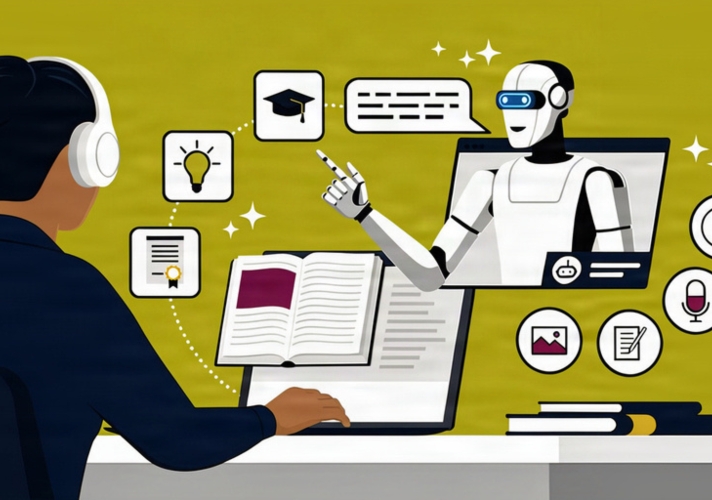

Like everyone else, we've watched artificial intelligence arrive in our lives faster than anyone could have imagined.
If someone had told us 20 years ago that we'd be using machines to help write articles, generate images, answer questions and support business decisions, we'd probably have laughed and suggested a return to the science fiction section of the library.
Yet here we are.
AI tools such as Microsoft Copilot, ChatGPT and Google's Gemini are now becoming part of everyday life. Businesses use them to draft emails, brainstorm ideas, analyse data and improve productivity. Consumers use them to plan holidays, create shopping lists and even help children with homework.
The technology may feel new, but the reality is that artificial intelligence has been around for much longer than most people realise.
A brief history of artificial intelligence
The foundations of AI were laid in the 1940s and 1950s by pioneering computer scientists and mathematicians. One of the most influential figures was Alan Turing, the British mathematician whose work helped crack the German Enigma code during the Second World War.
In 1950, Turing published a paper called Computing Machinery and Intelligence , posing a simple but groundbreaking question: Can machines think ?. He also proposed what would later become known as the Turing Test, a method for evaluating whether a machine could convincingly imitate human intelligence.
The term "artificial intelligence" itself was coined in 1956 by American computer scientist John McCarthy during the Dartmouth Summer Research Project on Artificial Intelligence. The goal was ambitious. Researchers believed that machines might one day learn, reason and solve problems in much the same way as humans.
Progress proved slower than expected. Computing power was limited, data was scarce and many early AI projects failed to deliver on their promise. However, the idea never disappeared. Over the following decades, advances in computing, the emergence of the internet and the explosion of digital data gradually created the conditions necessary for AI to flourish.
The AI boom
Fast forward seventy years and you could be forgiven for thinking we're drowning in AI-generated content.
Every day, thousands of articles, videos, social media posts and images appear online with varying degrees of human involvement. Some are genuinely useful. Others are little more than automated noise designed to attract clicks and advertising revenue.
This has led to concerns that the internet is becoming swamped by what has become known as "AI slop": low-quality content generated quickly and published with little oversight.
At the same time, headlines often focus on fears of mass job losses, sentient robots and machines replacing humans altogether.
It's no wonder some people wonder whether the robots are taking over.
Is this the end of humanity?
Probably not.
Popular culture has spent decades imagining futures dominated by machines. References to Orwell's 1984 , The Terminator and countless dystopian stories have shaped how many people think about advanced technology.
The reality is far less dramatic.
"Today's AI systems are incredibly impressive, but they are not conscious. They do not think independently, form opinions or understand context in the way humans do."
Instead, they identify patterns based on enormous amounts of information created, organised and supplied by people.
AI can generate content remarkably quickly, but speed is not the same as understanding.
Ask an AI tool to write an article and it can produce thousands of words in seconds. However, it cannot interview a customer, build a genuine relationship, understand subtle business politics or draw upon years of real-world experience.
Those remain very human skills.
Finding the right balance
Of course, there will always be people who use AI to generate content as quickly as possible in the hope of making money online. That's their choice.
But for most businesses, AI works best as a tool rather than a replacement.
At Eonic Digital, we've found that AI can dramatically improve efficiency when used correctly. It can help with research, idea generation, data analysis, coding assistance and content planning. What it cannot do is replace the strategic thinking, industry knowledge and quality control that makes content genuinely valuable.
The best results often come from combining human expertise with AI capabilities.
Think of AI as an exceptionally fast assistant rather than an autonomous replacement for your team.
What does this mean for the future of digital?
Despite the headlines, humans are nowhere near obsolete.
In fact, the rise of AI is increasing the importance of critical thinking, creativity and expertise. As more AI-generated content enters the market, audiences are becoming better at recognising the difference between information that is merely generated and information that is genuinely useful.
Businesses that succeed in the coming years will be those that use AI responsibly while maintaining human oversight.
✅ Accuracy still matters.
✅ Experience still matters.
✅ Trust still matters.
AI is only as good as the data, instructions and guidance provided by the people using it. Without human input, review and judgement, even the most advanced systems can make mistakes, misunderstand context or produce misleading information.
The future is human-led
Artificial intelligence is one of the most significant technological developments of our generation. It will continue to change how we work, communicate and create digital experiences.
But rather than replacing humans, it is far more likely to become another tool that helps people do their jobs more effectively.
The printing press did not eliminate writers.
Calculators did not eliminate mathematicians.
The internet did not eliminate businesses.
Likewise, AI is unlikely to eliminate humanity.
Instead, it's giving us a powerful new set of tools. The businesses that thrive will be the ones that learn how to combine the efficiency of AI with the creativity, expertise and judgement that only people can provide.
And that's a future worth looking forward to.